

Poorly Soluble Drugs: From Dissolution to Absorption
Poorly Soluble Drugs: From Dissolution to Absorption
How Amorphous Solid Dispersions Move from Formulation Concept to Commercial Product
Poor aqueous solubility remains one of the most persistent barriers to the oral development of small-molecule drugs. Drawing on a 2026 perspective in Nature Reviews Drug Discovery and other recent literature, this article examines how amorphous solid dispersions (ASDs) have evolved from a formulation option into a commercially established platform. It compares the practical operating windows of spray drying and hot-melt extrusion, and considers the decisions that connect formulation design with scale-up and commercial manufacture. The central point is straightforward: a useful formulation strategy must be built around the physicochemical profile and development goals of the individual molecule, with dissolution, precipitation, absorption, stability and manufacturability assessed as an integrated system.
Key Takeaways
1. Poor Solubility: A Hidden Barrier in Oral Small-Molecule Development
Potent target activity does not, by itself, make a compound an effective oral medicine. After an oral dose, a drug generally has to enter solution before it can cross the intestinal epithelium and reach the systemic circulation. Low aqueous solubility, as seen in Biopharmaceutics Classification System (BCS) classes II and IV, can lead to incomplete dissolution, inadequate absorption and greater interpatient variability in exposure. In some cases, increasing the dose produces only a limited gain in exposure. For BCS class IV compounds, low permeability may remain a separate constraint even after dissolution has been improved.
A 2026 perspective in Nature Reviews Drug Discovery identifies amorphous solid dispersions (ASDs) and lipid-based formulations (LBFs) as two leading approaches for improving the oral delivery of poorly water-soluble small molecules. Formulation decisions are consequently moving earlier in development, where they can inform candidate selection as well as clinical strategy.
2. Market Context: Why Formulation Development Is Increasingly Outsourced
The growing number of poorly soluble candidates, more complex development pipelines and pressure to reach the clinic faster are increasing demand for specialist formulation partners. The need is not limited to manufacturing capacity. Sponsors also require expertise in solid-state characterization, solubility-enabling technologies, analytical development, clinical supply and commercial scale-up.
Grand View Research estimates that the global formulation development outsourcing market will expand from USD 40.1 billion in 2025 to USD 79.8 billion in 2033, representing a CAGR of about 9.1% from 2026 to 2033. Its model assigns 65.3% of 2025 revenue to oral formulations and 27.6% to oncology. These are third-party market estimates: they are useful directional indicators, but they should not be read as the addressable revenue of any individual service provider.
3. ASD: From Formulation Option to Product Platform
3.1 What Is an Amorphous Solid Dispersion?
An ASD is a solid dispersion in which the drug is present in an amorphous, molecularly dispersed or highly dispersed state within a polymer-based matrix. It is typically processed further into a final dosage form such as a tablet or capsule. Unlike a crystalline drug, an amorphous drug does not have to overcome the full crystal lattice barrier during dissolution and may therefore provide faster dissolution and higher apparent solubility. The polymer can also delay nucleation and crystal growth, helping to sustain supersaturation.
ASD is not a universal formulation. Drug-polymer miscibility, drug loading, hygroscopicity, residual solvent, thermal stability and the long-term risk of recrystallization can all determine whether a candidate succeeds. Development should begin with the API solid form, glass transition temperature (Tg), melting point, solubility and chemical stability, then progress toward a formulation and process window that remains viable at scale.
3.2 Commercial Evidence Across Therapeutic Areas
The marketed ASD products compiled in the same perspective show that the technology is no longer a niche solution reserved for exceptional molecules. Commercial products now span infectious disease, oncology, immunology and rare diseases. Early products used processes such as solvent evaporation and fluid-bed granulation; spray drying (SD) and hot-melt extrusion (HME) have since become prominent commercial manufacturing routes.
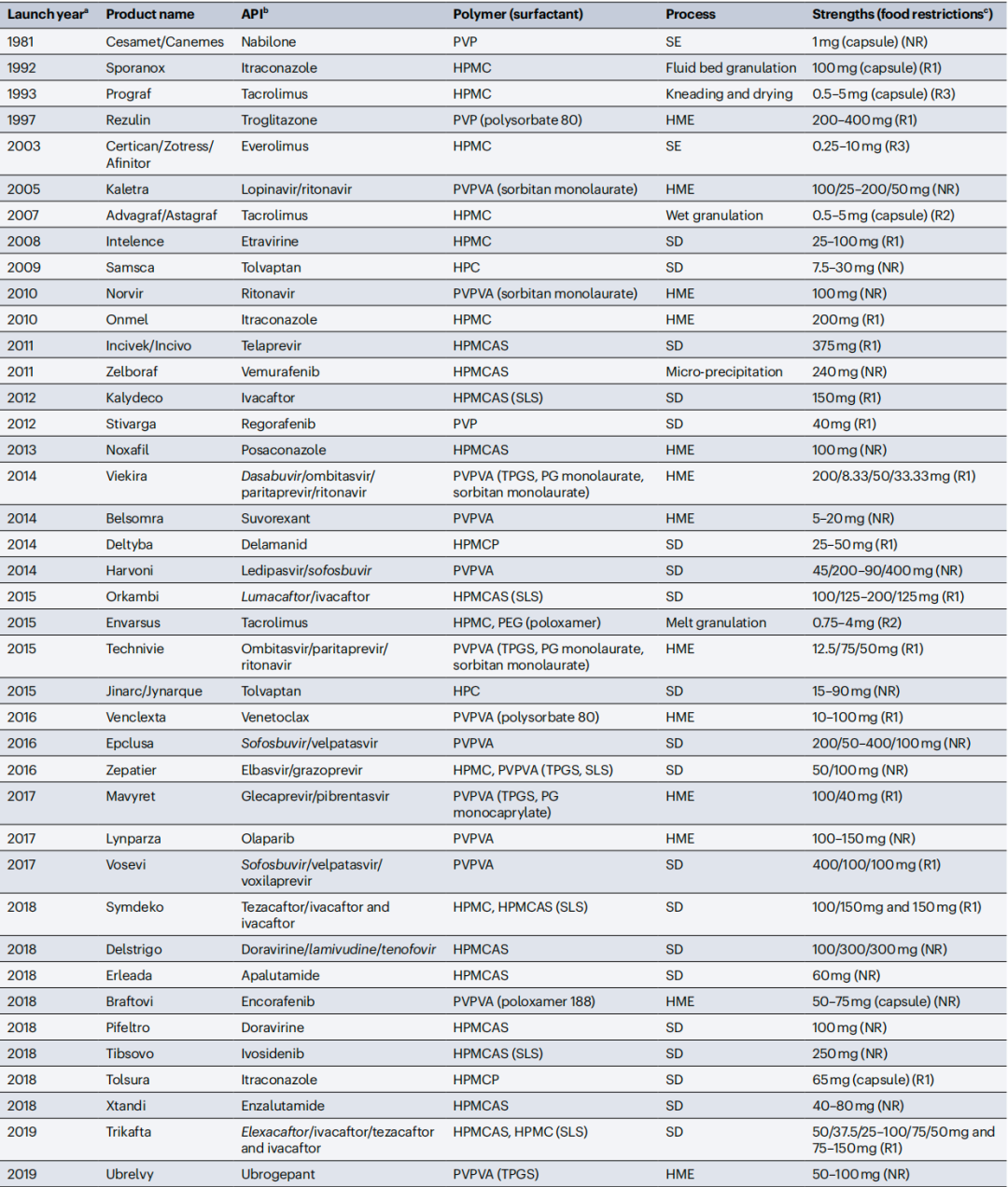
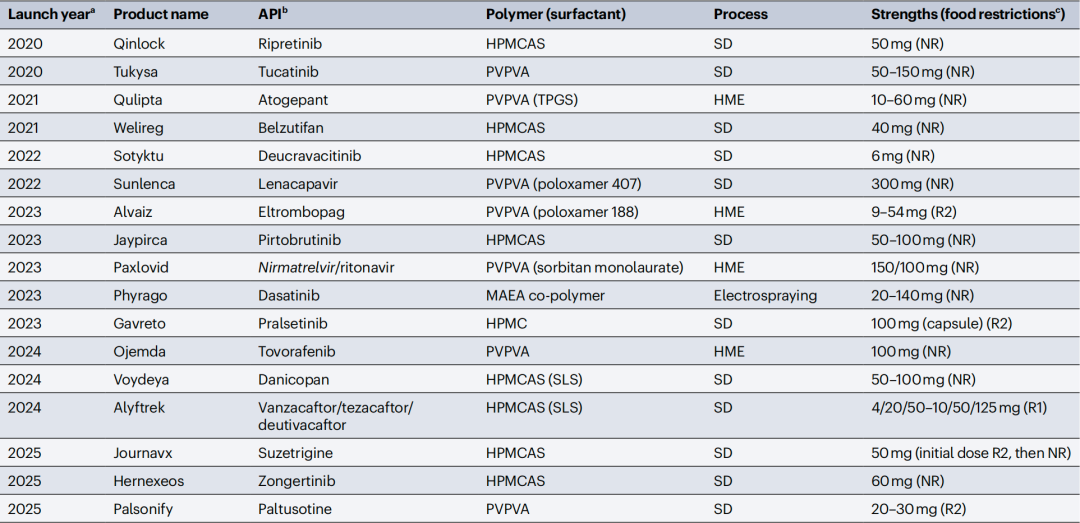
Table 1 | Selected commercially significant ASD products launched worldwide, 1981-2025. PVPVA, polyvinylpyrrolidone-vinyl acetate copolymer; HPMCAS, hydroxypropyl methylcellulose acetate succinate.
HPMCAS and PVPVA appear repeatedly among these products. That record does not make their formulations transferable from one API to another: dose, food effect, stability, equipment and the properties of the drug itself can all change the preferred polymer-process combination. The more useful lesson from Table 1 is that ASD development now follows a commercially tested path from material screening and process selection to scale-up control.
3.3 Where ASD Fits: Not a Simple Substitute for Lipid-Based Formulations
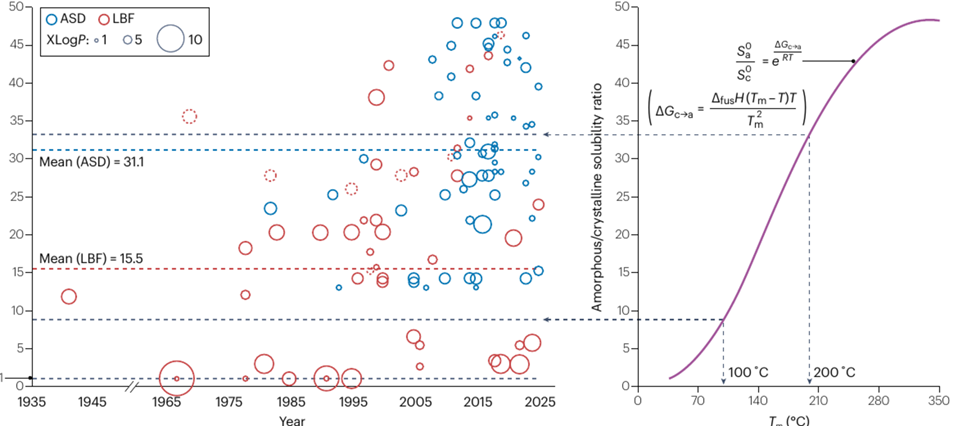
Figure 1 | Use of lipid-based formulations (LBFs, red) and amorphous solid dispersions (ASDs, blue) in approved products over time (left), and the relationship between melting point and the amorphous-to-crystalline solubility ratio (right).
The left panel of Figure 1 shows a marked increase in commercial ASD products over the past decade. Bubble size represents XLogP; the dashed values of 31.1 and 15.5 are not mean XLogP values and should not be used to infer that ASD products are more lipophilic. The broader analysis points instead to ASDs as an increasingly important option for high-melting-point compounds, where crystal lattice energy limits dissolution, while LBFs are often better suited to extremely lipophilic molecules. Selection should consider melting point, lipophilicity, dose, solubility, digestion behaviour and food effect rather than treating the two approaches as interchangeable.
The right panel illustrates a thermodynamic relationship: as melting point rises, the theoretical solubility advantage of the amorphous form over the crystal can increase. This makes high-melting-point drugs attractive candidates for ASD screening, but not automatic successes. Drug-polymer miscibility, drug loading, processing conditions and physical stability still determine whether a practical ASD can be made.
4. A Critical Distinction: Better Dissolution Does Not Guarantee Better Absorption
4.1 Supersaturation and Precipitation: The Second Barrier
A common development mistake is to equate faster in vitro dissolution with better in vivo absorption. Once released into gastrointestinal fluids, a solubility-enabled drug may form only a transient supersaturated solution. If the formulation does not adequately inhibit nucleation and crystal growth, the dissolved drug can precipitate before it is absorbed.
A formulation assessment should therefore examine three linked stages:
Solubility or dissolution in a single aqueous medium is rarely enough to answer these questions. A stronger assessment combines multiple pH conditions, biorelevant media, transfer dissolution, precipitation kinetics, permeability and stability testing.
4.2 In Vivo Precipitation Beyond the Gastrointestinal Tract
Precipitation is not confined to the gastrointestinal tract. A 2024 review in Advanced Drug Delivery Reviews describes how some poorly soluble drugs may form solid deposits in vivo, potentially altering tissue distribution, clearance and pharmacokinetics. The risk depends on solubility, membrane permeability, the local tissue environment and local drug concentration. This is a molecule-specific risk rather than a universal outcome for poorly soluble oral drugs.
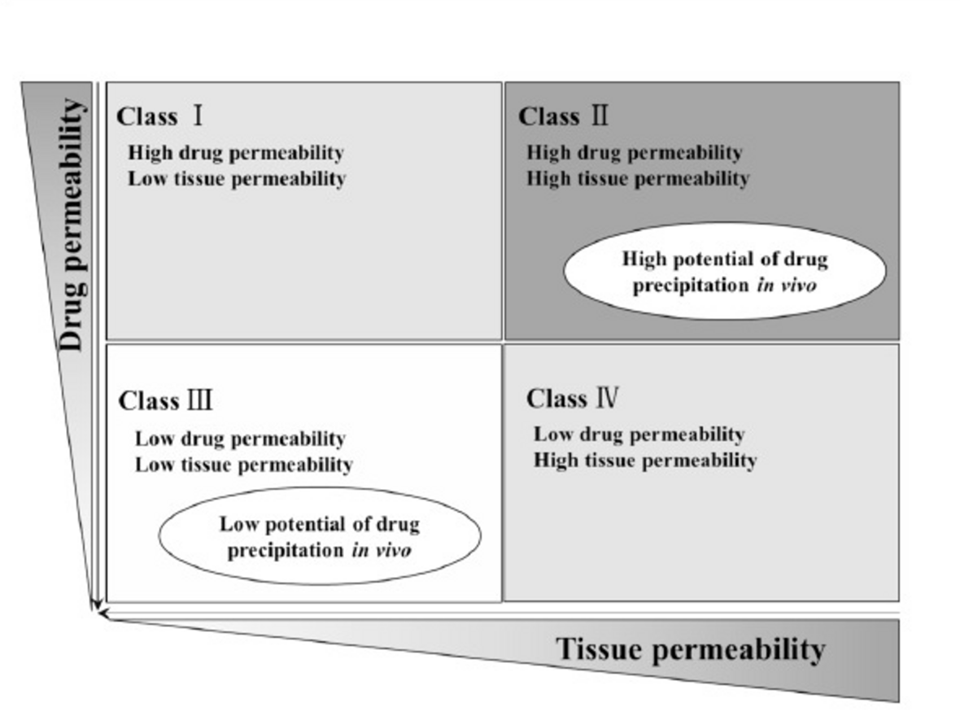
Figure 2 | Framework for in vivo precipitation risk based on drug permeability and tissue permeability. Class II (high drug permeability and high tissue permeability) is associated with a higher deposition risk.
Figure 2 classifies Class II compounds (high drug permeability and high tissue permeability) as having a higher risk of in vivo deposition, whereas Class III compounds (low drug permeability and low tissue permeability) are assigned a lower risk. The framework is useful for risk identification, but a specific drug product still requires biopharmaceutic and pharmacokinetic evaluation. Total drug concentration alone is insufficient; unbound drug concentration, the timescale of precipitation and the behaviour of formulation components under physiological conditions also matter.
5. Process Selection: Spray Drying vs Hot-Melt Extrusion
5.1 Comparison of the Core Process Principles
| Dimension | Spray Drying (SD) | Hot-Melt Extrusion (HME) |
|---|---|---|
| Core principle | Rapid solvent removal to form amorphous particles | Continuous mixing and processing in the molten state |
| Use of solvent | Requires an organic solvent system | Generally avoids volatile organic solvents |
| Typical fit | Compounds with a limited thermal processing window | Compounds stable within a practical melt-processing window |
| Key variables | Solvent system, solution concentration, atomization, inlet/outlet temperature and residual solvent | Melt-processing window, thermal degradation, torque and specific mechanical energy |
| Continuous processing | Continuous feed and drying are possible; downstream continuity depends on line design | Inherently continuous extrusion process |
| Material handling | Particle size, density and flowability require control | Extrudate form and milling performance require control |
5.2 Performance Depends on the Drug-Polymer Combination
The practical difference between SD and HME comes down to the API, polymer and target dosage form. A process that works well for one compound can behave very differently with another. A 2025 model study using indomethacin illustrates the trade-off.
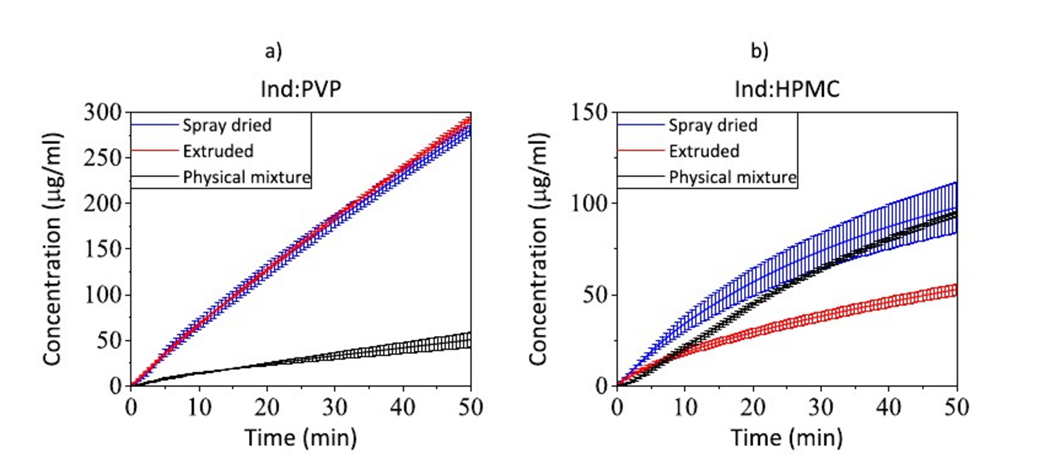
Figure 3 | Intrinsic dissolution performance of spray-dried, hot-melt-extruded and physically mixed samples in PVP (left) and HPMC (right) systems.
In the PVP system shown in Figure 3, the two manufacturing routes produced similar initial dissolution. In the HPMC system, the spray-dried material dissolved appreciably faster than the hot-melt-extruded material. The finding belongs to this specific model system, but it makes a broader practical point: process performance cannot be ranked independently of the API and polymer formulation.
6. Commercialization Challenges: From Laboratory Formulation to Drug Product
A promising laboratory dissolution profile is only the starting point. At pilot and commercial scale, changes in batch size, equipment and material attributes can affect blend uniformity, particle size, tabletability, coating performance and final dissolution. Lot-to-lot variability in APIs and excipients may also become more consequential as the process scales.
Under the Quality by Design (QbD) principles described in ICH Q8, development teams should define the Quality Target Product Profile (QTPP), identify critical quality attributes (CQAs), critical material attributes (CMAs) and critical process parameters (CPPs), and establish a control strategy through risk assessment and design of experiments (DoE).
Formulation development, analytical methods, stability studies and process scale-up should advance in parallel. Leaving these activities to be reconciled late in development creates avoidable technical and regulatory risk.
7. Industry Perspective: Connecting API and Drug Product Development
For poorly soluble small molecules, 2Y-Biopharma provides preformulation studies, formulation and analytical development, stability studies, clinical and registration-batch manufacturing, process validation and commercial production, supported by spray-drying and hot-melt-extrusion platforms. These capabilities can be coordinated with ChemExpress solid-state research, API process development and regulatory CMC services, reducing information gaps between API characterization, formulation design and scale-up.
Successful formulation development for a poorly soluble drug depends on balancing the molecule's properties and clinical requirements with dissolution, absorption, product stability and manufacturing feasibility. When solid-state research, formulation screening, biopharmaceutic evaluation, analytical development and process scale-up are connected, an in vitro dissolution advantage has a better chance of becoming reproducible clinical exposure—and ultimately a manufacturable medicine.
Frequently Asked Questions
Q1: How is a polymer selected for an amorphous solid dispersion?
A: Polymer selection begins with drug-polymer miscibility and the likelihood of stabilizing the drug in both the solid state and the dissolution medium. Glass transition temperature, hygroscopicity, hydrogen-bonding potential, solvent compatibility, thermal processability and the polymer's ability to inhibit precipitation are assessed together. Screening several polymers and drug-to-polymer ratios is usually more informative than choosing a carrier from precedent alone.
Q2: What determines the maximum drug loading in an ASD?
A: There is no universal target. The practical limit is set by the drug's solubility in the polymer, phase-separation and crystallization risk, dose, dissolution performance and the size of the final dosage form. A higher loading can reduce tablet or capsule size, but may narrow the stability margin and weaken control of supersaturation; the selected loading is therefore a product-level trade-off rather than a single material property.
Q3: Why do amorphous solid dispersions recrystallize during storage?
A: Recrystallization can be triggered by molecular mobility, moisture uptake, temperature excursions, phase separation or insufficient drug-polymer interaction. Risk is managed through polymer and drug-load selection, control of residual solvent and water, an appropriate manufacturing history, protective packaging and stability studies that track both solid form and product performance throughout shelf life.
Q4: Which analytical methods are used to characterize an ASD?
A: No single method is sufficient. X-ray powder diffraction and differential scanning calorimetry are commonly used to assess crystallinity and thermal behaviour, while dynamic vapour sorption, spectroscopy, microscopy and dissolution testing can probe moisture sensitivity, drug-polymer interactions, phase separation and performance. Method sensitivity is important because low levels of crystallinity may still affect stability or dissolution.
Q5: What should sponsors look for when outsourcing poorly soluble drug formulation to a CDMO?
A: The strongest partner is rarely the one with a single enabling technology. Sponsors should look for evidence that the CDMO can connect solid-state characterization, polymer and process screening, biorelevant performance testing, analytical development, stability, GMP manufacture and regulatory CMC support—and can transfer the formulation from laboratory scale to a commercial site without losing product understanding. Regulatory inspection history should also be reviewed at the site and dosage-form level. ChemExpress's drug-product subsidiary 2Y-Biopharma, for example, completed a U.S. FDA pre-approval inspection for oral solid dosage forms in June 2026 with no Form 483 observations and subsequently received the Establishment Inspection Report. Together with its spray-drying, hot-melt-extrusion, lyophilization and fluid-bed ASD capabilities, this provides a practical foundation for supporting poorly soluble molecules from formulation development through commercial production.
References
[1] Ueda K, Porter CJH, Goodwin A, et al. The expanding role of formulations to enable oral delivery of poorly water-soluble drugs. Nature Reviews Drug Discovery. 2026.
[2] Lou Z, et al. In vivo deposition of poorly soluble drugs. Advanced Drug Delivery Reviews. 2024;211:115358.
[3] Martynek D, et al. Stability and recrystallization of amorphous solid dispersions prepared by hot-melt extrusion and spray drying. International Journal of Pharmaceutics. 2025;672:125331.
[4] International Council for Harmonisation. ICH Q8: Pharmaceutical Development.
[5] Grand View Research. Formulation Development Outsourcing Market Size, Share & Trends Analysis Report, 2026-2033.